

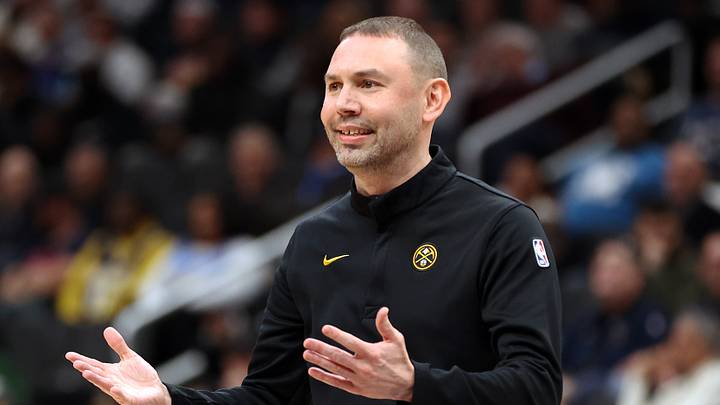
The Denver Nuggets were the NBA's best offense last season. They were the best three-point shooting team in the NBA, making 39.1% of their three-point attempts. But if they missed and failed to get the offensive rebound, it was often off to the races the other direction for their opponents. The Nuggets struggled to get back on defense, to put it nicely, and head coach David Adelman is looking to make crashing the boards to help slow the pace of their opponents a priority this year.
In fact, the Nuggets were the worst team in the league at transition defense on a per-possession basis, allowing a whopping 1.22 points per possession, which translated to 24.0 points allowed per game. The Nuggets have to improve their transition defense in 2026-27. That's why Adelman said at Nuggets media day that he wants the Nuggets to crash the offensive boards to help slow the opposing team down.
"Our half-court defense wasn’t bad… But I think just to slow transition down, to help our roster, is important, and that means more physicality in the offensive rebound," Adelman said.
The Nuggets need to slow their opponents down
Adelman should have no shortage of physicality for his new scheme after the Nuggets showed up looking like they had spent their summers hitting the gym hard. And to get through and box out or find a loose, long rebound requires hustle, quickness, and strength. But how does hitting the offensive glass translate to slowing the opponents, you may ask? It gets a defender in the way and disrupts the outlet pass, or stops their opponent from getting a head start down the court in the opposite direction.
And Adelman is right. The Nuggets weren't the worst half-court team, but they were a bottom-third team, ranking 21st. Physicality will shore that issue up. But to really control the game, the Nuggets need to slow down, not speed up.
Offensively, the league's top-ranked offense was only 21st in pace. That allowed the Nuggets to set up their offense so Nikola Jokic could pick apart the defense and find the open player for an easy bucket. Now, if the Nuggets start controlling the pace defensively by slowing their opponents in transition, bumping them around, and being aggressive at chasing down a rebound, it goes a long way toward improving that dead-last transition defense rank.
And it probably results in a few extra wins. The Nuggets will likely have a new defensive scheme this year with the addition of new assistant coach Dave Joerger, who's a defensive specialist. And to maximize it, they'll need to set up first. Attacking the glass to slow down their opponent is a good first step in remedying the transition defense problem to allow the half-court defense to function better.
 Add us as a preferred source on Google