

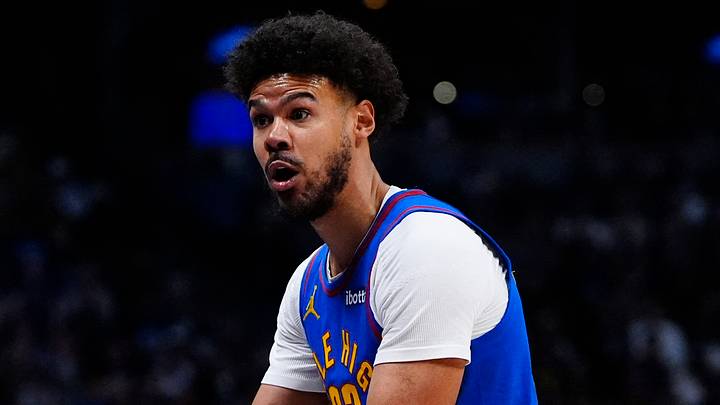
Are the Denver Nuggets setting themselves up for a gap-year in 2027-28? That's the feeling I get from the Nuggets choosing to hold on to Cameron Johnson and his expiring contract, along with the other moves they made this offseason.
Most Nuggets fans expected Johnson to be the one traded to clear salary cap space as one of their moves to get back under the NBA's second-apron luxury tax threshold. But the Nuggets instead decided to trade Peyton Watson to the Cleveland Cavaliers to replenish draft capital they had lost over the previous few years.
But when you look at where the Nuggets would be next summer without either Johnson's or Watson's contract, it makes sense that the team could be angling for a gap year.
The Nuggets' moves point toward a potential gap year in 2027-28
The first move that set this gap year notion in motion was matching the offer sheet the Oklahoma City Thunder gave Spencer Jones. The Nuggets matched the two-year, $12 million offer. It was a smart match, with one unnamed Nuggets front office executive calling it a "no-brainer" decision. It forced the Nuggets over the second apron line, but that was likely coming to keep Jones anyway.
At six million next season, Jones is a good, affordable backup. Perhaps more affordable than they would find on the open market next summer for a comparable player, helping with the salary cap crunch.
But the more pointed tell is keeping Johnson over Watson. Watson would be on the books for around $21 million next season. Johnson isn't under contract after this year, and that makes it feel like the Nuggets traded Watson for Johnson and his expiring contract, almost like he's now a one-year rental.
Bennett Durando of the Denver Post said, "The Nuggets decided they preferred Johnson's expiring salary, Spencer Jones' cheaper extension, and an unprotected first-rounder rather than what they would have to sacrifice for a long-term relationship with Watson."
The Nuggets probably want to reset their "repeater tax" clock next year
That sounds like the Nuggets wanted to keep their options open. Without Cam or Watson's contract on the books, the Nuggets could potentially get under the luxury tax threshold for 2027-28. Because the Nuggets finished this past season under the luxury tax, they would need to get back under the threshold one more time in the next three seasons of the four-year clock to do so.
And it's a big deal for the notoriously cheap team. The repeater tax at the Nuggets' current cap level for 2026-27 is about $75 million, roughly double what it would be if the Nuggets' repeater clock were reset.
There just seems to be something else up the Nuggets' sleeve for the direction they're going. And from what I see, it seems like a gap year to reset the repeater tax is coming sooner rather than later.
 Add us as a preferred source on Google