

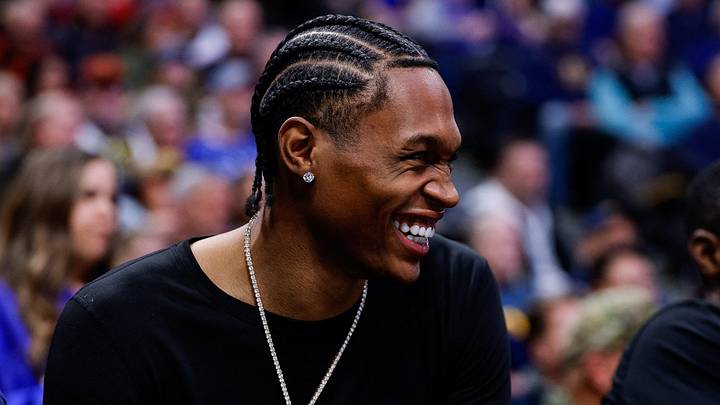
There's been no shortage of speculation on Peyton Watson's options next season. Do the Denver Nuggets sign-and-trade him, and if so, to whom? Does he take the qualifying offer, or will he decide to extend his contract with the Nuggets on a deal that's for less money than he started out wanting? We don't yet know. But I'll rank the outcomes that I think are from least likely to most likely and explain what that option looks like for Watson and the Nuggets.
Least likely outcome: Playing on the qualifying offer
There isn't much incentive for Watson to take a bet on himself with the qualifying offer of only $6.5 million. He would have to be assured playing time and avoid injury, and match his performance from last January for most of the season if he wants to clear the $25 million average annual salary range he's been asking for.
Unfortunately, the Nuggets gave Christian Braun a five-year, $125 million extension before last season began, and Watson has been using that as the bar to clear. If he did choose this route, and the Nuggets are offering a reported $16-18 million per year, and his season didn't pan out like Watson had hoped, he could be leaving extra money on the table for multiple years.
However, having Watson on the qualifying offer wouldn't be so bad for the Nuggets. They would have an easier path to avoiding the NBA's second-apron luxury tax penalty threshold and would be able to avoid a lot of fines. But they would almost assuredly lose Watson in free agency next summer.
Middle-of-the-road outcome: The sign-and-trade
It's certainly in the Nuggets' best interest to see what they can get in return for the restricted free agent Watson, and they are doing just that. Shams Charania reports that the Nuggets are in "active trade talks with multiple teams on a potential Watson sign-and-trade, including the Cleveland Cavaliers, Milwaukee Bucks, and Los Angeles Clippers," according to his sources.
But this is a complicated route now that the Nuggets are the only team over the second apron threshold. The Nuggets can't take back a player in the sign-and-trade and remain above the second apron threshold. They would be hard-capped there, which is probably fine for the front office. It would give them an excuse to avoid a lot of luxury tax penalties.
The easiest path in this scenario would be a plethora of draft picks, because the Nuggets could sign-and-trade Watson and stay over the apron if they wanted to by taking back only picks. They wanted a "Walker Kessler" level return for Watson, to include multiple first-round picks.
However, the Nuggets haven't been offered a first-rounder by any of the suitors. That could become a sticking point in any trade.
Most likely outcome: Watson and the Nuggets sign a short-term deal
I don't think Watson and his agents at Klutch are going to let him potentially forfeit over $10 million on a one-year gamble, let alone what it could add up to if it backfired. It would seem likely that the two sides meet somewhere around the $18-20 million-a-year range for two years, possibly three. Watson would have the chance to still show he's got what it takes for a larger deal, and the Nuggets would still have the chance to trade him if he doesn't.
It just might take until the fall to be completed. Last year, Jonathan Kuminga and the Golden State Warriors were in a similar restricted free agency standoff, and it didn't resolve until September 30th.
The only problem with this outcome is that the Nuggets would likely have to trade one of Braun, Cameron Johnson, or, gulp, Aaron Gordon to avoid the second apron.
The situation is fluid at the moment. Eventually, we'll have our answers. But for now, all we can do is speculate.
 Add us as a preferred source on Google